Publications
Jandré Ernst
8th Apr, 2026
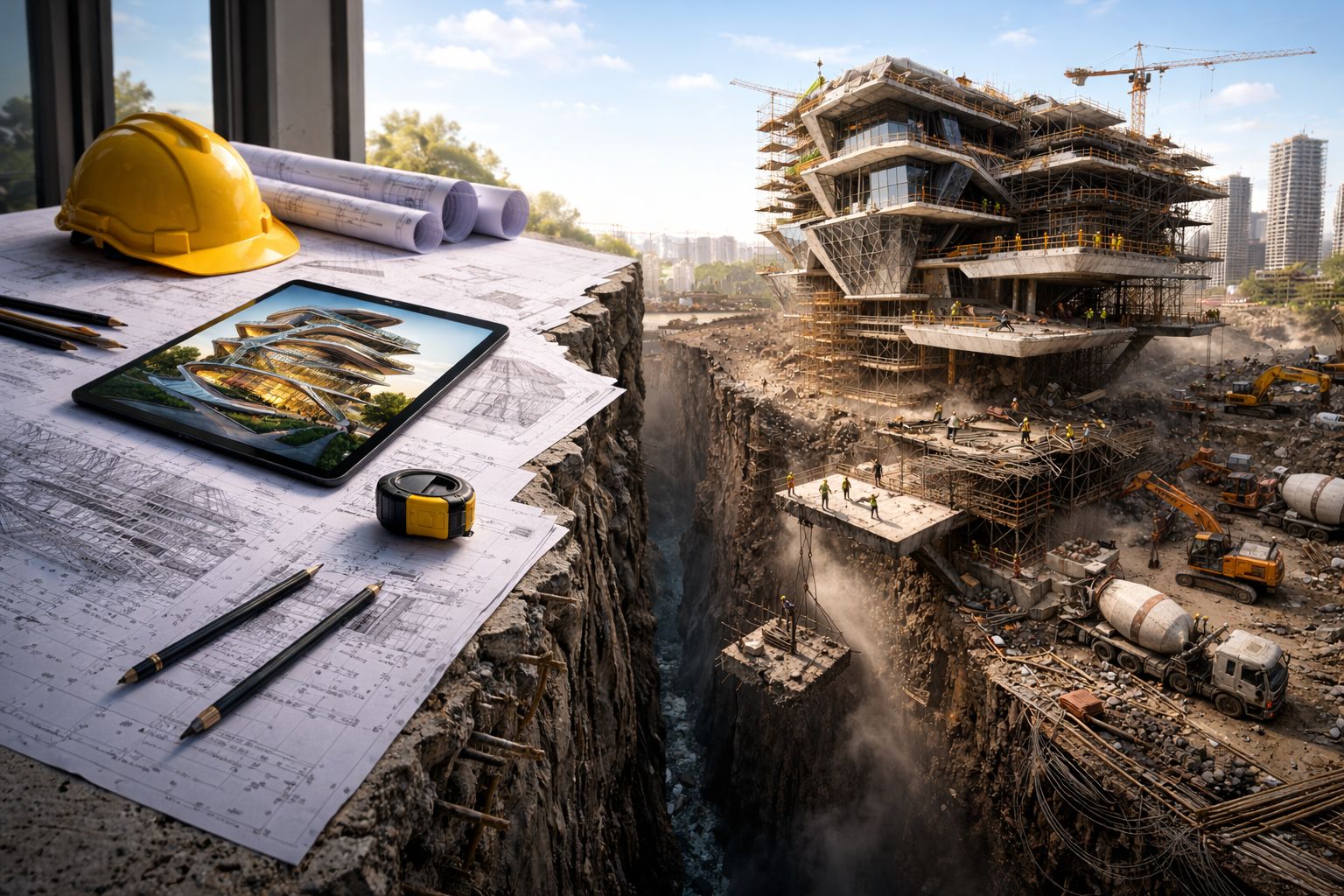
In many projects, constructability is treated as an implicit outcome of good design. If the drawings are coordinated and the specifications are complete, the assumption is that construction will naturally follow. Yet, from a site perspective, the gap between “designed” and “buildable” remains one of the most persistent sources of delay, cost overruns, and frustration.
Constructability — sometimes referred to as buildability — is the extent to which a design facilitates ease of construction, considering sequencing, access, logistics, temporary works, tolerances, safety, and resource availability (CII, 1986). While designers and consultants are deeply focused on compliance, performance, and aesthetics, contractors must navigate the realities of assembling the project under constraints rarely visible on paper.
This disconnect is not due to incompetence on either side. Rather, it reflects differing priorities and perspectives.
Design Completion vs Construction Readiness
Consulting project managers often measure progress by design deliverables: concept, developed design, technical documentation, issued-for-construction (IFC). However, “IFC” does not automatically equate to “construction-ready”.
A drawing may be technically correct yet still generate site inefficiencies:
These issues rarely appear in design review meetings but emerge quickly during construction, typically as RFIs, delays, or variation claims.
Research consistently shows that early contractor involvement and constructability reviews reduce rework, improve cost certainty, and shorten project durations (Gambatese et al., 2017).
Sequencing: The Missing Layer
Construction is fundamentally about sequence. What can be built is governed not only by geometry but by order.
Consultants often review spatial coordination — “Does it fit?”
Contractors ask — “When and how does it go in?”
For example:
Without explicit sequencing consideration, even coordinated designs can produce bottlenecks and trade stacking.
Temporary Works: The Invisible System
One of the most overlooked aspects of constructability is temporary works — scaffolding, formwork, propping, access platforms, hoardings, lifting strategies.
These systems are rarely represented in design models yet are critical to project feasibility.
Design decisions significantly influence temporary works complexity:
Ignoring temporary works during design often results in programme extensions or unforeseen costs.
As the Institution of Civil Engineers notes, temporary works failures and inefficiencies remain a major risk area when insufficiently considered at design stage (ICE, 2019).
The Cost of Late Realisation
When constructability issues surface during construction, the consequences are amplified:
At this stage, even minor design adjustments can trigger cascading impacts.
MacLeamy’s Curve illustrates this clearly: the ability to influence cost decreases as the project progresses, while the cost of changes increases exponentially (MacLeamy, 2004).
Bridging the Gap
For consulting-side project managers, constructability is not about replacing the contractor’s expertise — it is about proactively integrating construction thinking into project leadership.
Practical steps include:
Most importantly, it requires recognising that coordination alone is not constructability.
Final Reflection
Projects succeed when design intent and construction reality align. Constructability is the bridge between the two.
For project managers operating from the consulting side, the opportunity lies in asking a deceptively simple question throughout the design process:
“Yes — but how will this actually be built?”
That question, asked early and often, can prevent months of delay and millions in avoidable cost.
References
Construction Industry Institute (CII), 1986. Constructability: A Primer. Austin: CII.
Gambatese, J., Pestana, C. & Lee, H.W., 2017. ‘Alignment between design and construction: Constructability principles’, Journal of Construction Engineering and Management, 143(6).
Institution of Civil Engineers (ICE), 2019. Temporary Works: Principles of Design and Construction. London: ICE Publishing.
MacLeamy, P., 2004. ‘Collaboration, Integrated Information and the Project Lifecycle’, Construction Users Roundtable.
EARLIER POSTS
.png)
More Than Numbers
21st Sep, 2026
Professional Fees for Quantity Surveyors
3rd Sep, 2026

Artificial Intelligence is leading the biggest shakeup in the Built Environment!
8th Jul, 2026
Why Variation Orders Can Make or Break a Construction Project
2nd Jun, 2026
Joining a Project Mid-Construction: Lessons Beyond the Textbooks
7th May, 2026
Constructability: The Blind Spot Between Design and Delivery
8th Apr, 2026
.png)
Project Communication: The Foundation Of Construction Project Management
25th Feb, 2026
.png)
From Measurement to Strategy: How the Modern South African QS Adds Value Beyond Cost Control
17th Oct, 2025
.png)
The AI Co-Pilot: Revolutionizing a Construction Project Manager's Day
16th Sep, 2025

Training at AGORA: Real Voices, Real Growth
8th May, 2025